You walk up to the gate, skip the boarding pass, stare at a camera for a second, and the door opens. That is biometric boarding. It is already common at many US airports, and more airlines keep adding it. If you have a passport, you can usually use it. If you would rather not, you can usually still board the old way.
The short version: the camera takes your picture, compares it to the photo the government already has from your passport or visa file, and confirms the two match. Nothing about it changes who gets on the plane. It changes how the agent checks that you are you. For a plain-language rundown of the wider system behind it, the travel news desk has covered the rollout as it goes. For related coverage, see Europe's new border checks have a start date — here's what changes.
How the gates actually work
Biometrics are just body measurements used for identification: fingerprints, iris patterns, faces. The Biometrics Institute lists face recognition as one of several physiological modalities, alongside fingerprints, vein patterns, and even gait. Airports settled on the face because it needs no touch and no extra hardware in your hand.
The process runs in two steps. First comes enrollment: your biometric data gets captured and stored once. For US border systems, that already happened when they issued your passport or took your photo at a border crossing. Second comes verification, which is what the gate does. As Wikipedia's overview of biometrics describes it, verification is a one-to-one comparison: the system checks your live capture against one specific stored template, the one attached to your identity. That is different from identification mode, a one-to-many search across a whole database. Boarding gates run the narrower check, which is faster and less invasive than a database sweep.
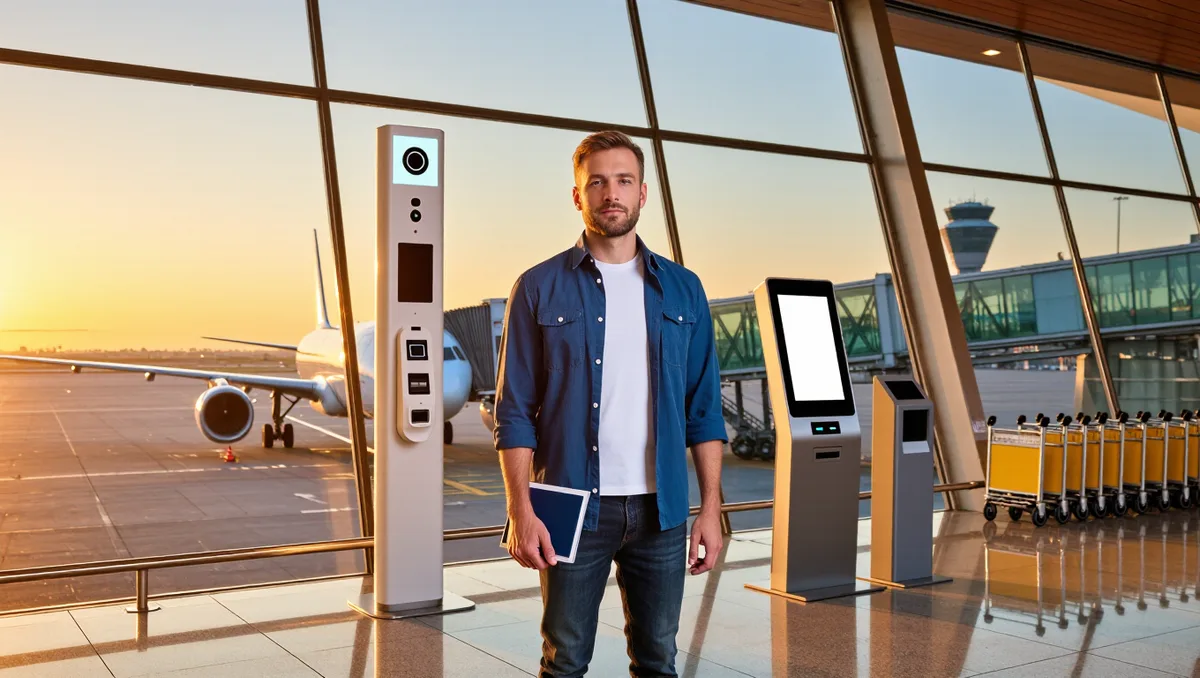
At the gate itself, the sequence is short. You step into the camera's frame. The system pulls the passport photo linked to your flight record. It compares the two. If they match, the gate opens and the airline gets confirmation that you boarded. If they do not, an agent steps in with a scanner and a boarding pass, same as before.
Where your face data lives
This is the part most travelers actually want to know, and the honest answer is that the government side is substantial. The Department of Homeland Security explains that biometrics support everything from immigration benefits to travel facilitation, and that its Office of Biometric Identity Management runs the Automated Biometric Identification System, or IDENT. DHS states that IDENT holds more than 320 million unique identities and processes more than 400,000 biometric transactions per day. Your passport photo sits inside that ecosystem.
What the airline keeps is a separate question. Airlines generally receive a match confirmation rather than a copy of your face image. The camera at the gate is usually part of the government's system, not the airline's. The exact retention rules for images captured at boarding vary by program, and DHS has published reports on face capture use cases, so the details are worth checking if retention is the question that decides it for you.
The privacy questions travelers keep asking
Can you opt out? For boarding, generally yes. The gates are an option layered on top of document checks, not a replacement that leaves you stranded. Tell the agent you would prefer the manual check and you will board with your boarding pass like usual. That is the single most useful thing to know if you are uneasy about the cameras.
Is the data shared? DHS says it shares biometric information with the Departments of Defense and Justice through established interoperability arrangements, with filtering and privacy controls described on its side. What that means in practice for one traveler's face image is harder to pin down from the outside, and it is a fair question to keep asking.
What about accuracy? Face recognition performs worse for some groups than others, and that has been a live research and policy question for years. The practical safeguard at the gate is the human: a mismatch routes you to an agent, not to a denial. If the camera fails, the fallback is the same document check that existed before.
What this means for your next airport run
Our analysis: biometric boarding is a convenience trade, and it is worth being clear-eyed about what you are trading. You give a system that already holds your passport photo one more live comparison, and in return you skip fumbling for a boarding pass with a roller bag in one hand. For most travelers, that trade feels small because the photo was already on file.
Where it genuinely helps: tight connections, family groups herding kids through the gate, anyone whose hands are full. Where it does not: if you are privacy-sensitive, the manual line still exists, and using it costs you maybe a minute. There is no prize for the camera.
One practical note if you are flying internationally: boarding is only one touchpoint. Border exit and entry checks use the same underlying identity files, and the rules differ by country. If your trip crosses into Europe, our piece on Europe's new border checks and what changes covers the other side of the passport control desk. And if you are weighing whether a trusted-traveler program is worth it alongside all this, our comparison of Global Entry or PreCheck and how to pick your faster line walks through where each one helps. This connects to our earlier piece, Global Entry or PreCheck how to pick your faster line.
The takeaway
Biometric boarding compares your live photo to a government-held passport photo, one-to-one, at the gate. The government's biometric holdings are large and centralized, per DHS's own figures. The airline gets a confirmation, not your face. Opting out remains possible, and the human fallback never went away. Know both doors before you fly, and pick the one that suits you.