The Dubai Gold Souk runs on an honest arithmetic that surprises first-time visitors: the gold itself has one price, published daily per gram by weight and purity, and every shop in the souk buys and sells against the same number. What you negotiate is the making charge — the labor premium on top of the metal — and that is negotiable everywhere, from the single-digit percentages on plain chains to much heavier markups on intricate machine-worked and hand-set pieces. Check the day's gold rate on your phone, and you are armed for every counter in Deira.
This is a sourced roundup of how the souk's pricing structure works, based on Dubai's hallmarking and retail-gold practice as of mid-2026; no purchase of ours is behind it, and prices move daily with the metal market. The house note applies: information, not financial advice — and gold bought as jewelry is a possession, not an investment product, whatever the rate board implies.
How is the price actually built?
Three components: the day's gold rate per gram, the weight of the piece, and the making charge. The rate is public — Dubai publishes and displays daily prices, and the souk's shop boards track them — so the first two components have no negotiation room at all. The making charge is quoted per gram or per piece and varies with complexity: plain 22-karat chains and bangles carry modest charges, while filigree, gem-set, and branded pieces carry charges that can exceed the labor they describe. Bargain on the charge, not the metal; a seller who "discounts the gold" is moving the charge and calling it something else.
What should you check before paying?
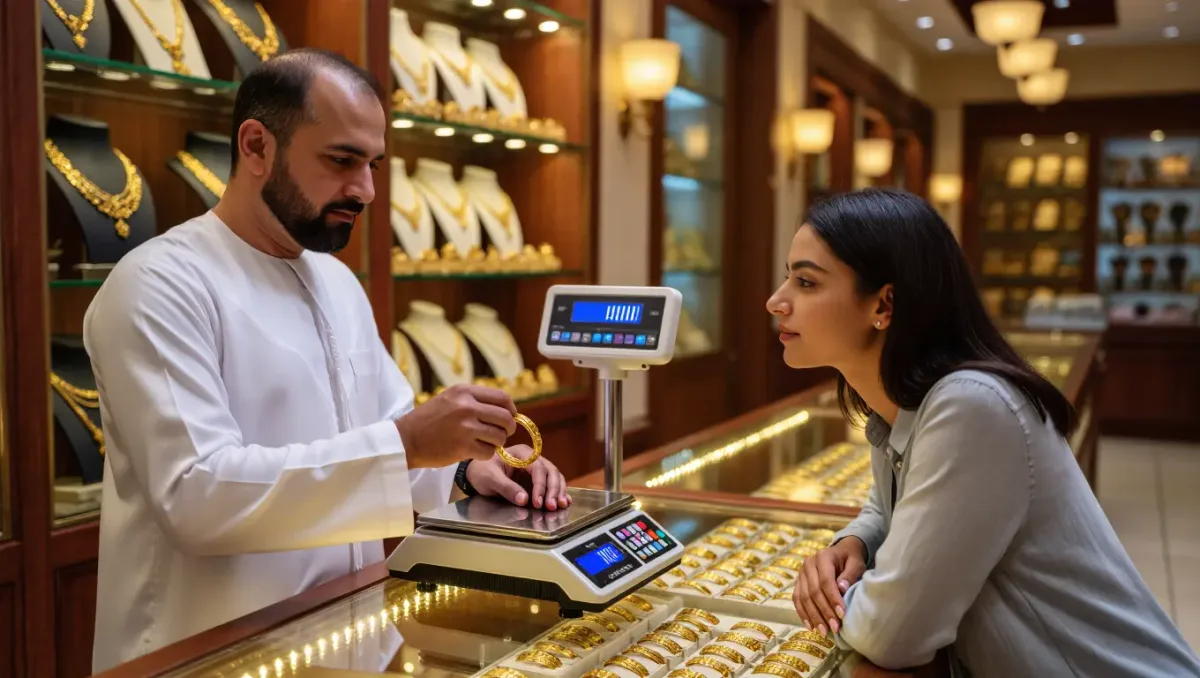
Purity stamps and hallmarking first: Dubai requires hallmarking of gold jewelry, and the karat mark — 24, 22, 21, 18 — should be stamped on the piece and stated on the receipt, along with the weight. Ask for the itemized receipt showing rate, weight, and making charge separately; the itemization is normal practice, and its absence is the clearest signal in the souk to walk. Weigh the piece on the counter scale in front of you. Gems are a separate market inside the souk — stones are typically priced with less public benchmarking than metal, so buyers who cannot grade should treat diamond and emerald purchases as trust purchases from established names.
Can you actually get a deal here?
Against home-country retail, yes, structurally: tight margins over the live gold price, competition among hundreds of adjacent shops, and a city that positions itself as a gold trading hub. The advantage is largest on plain 21k and 22k jewelry — Indian-subcontinent and Gulf designs where making charges are culturally low — and thinnest on branded boutique pieces sold worldwide. Cross-check any "souk price" against your home jeweler's quote for a comparable piece before you travel; the gap, not the display cases, should justify the purchase.
What about VAT and the tourist refund?
The UAE applies a 5 percent VAT, and gold jewelry purchases include it. Non-resident tourists can reclaim VAT on qualifying purchases through the departure-based refund scheme, which requires the retailer's registered tax-free form and minimum purchase amounts, processed at the airport before you fly. Factor the refund into the comparison math — it meaningfully narrows any gap — and factor the paperwork time at the airport into your departure plan, because the refund counters queue like everywhere else in DXB.
How do you bargain without insulting anyone?
The souk is a working market and negotiation on making charges is expected, brisk, and good-humored. The method: know the day's rate, pick the piece, ask the total, then negotiate the making charge specifically — not the whole price in the abstract. Get two or three quotes from different shops for the same or similar design; the quotes themselves do the arguing. Pay by card if you want the record, cash if the seller offers a visible incentive, and never send goods ahead with a courier you did not arrange.
- Check today's gold rate before entering the souk — it is public for a reason.
- Itemized receipt: rate, weight, making charge, karat, separate lines.
- Bargain on making charge only; discounts on "the gold" are theater.
- For stones without grading knowledge, stick to established jewelers.
The souk's best consumer protection is its own transparency: when every shop prices against the same public number, the only variable left is the one you are allowed to argue about.
Who should skip it?
Anyone who wants a piece identical to a home-market branded collection — the global brands price their Dubai boutiques much like their others. And anyone buying gold as a financial instrument rather than jewelry: souk retail spreads, making charges, and airport logistics make bullion markets the better venue for that job. The souk is for wearing, gifting, and the pleasant theater of a hard-won making charge.