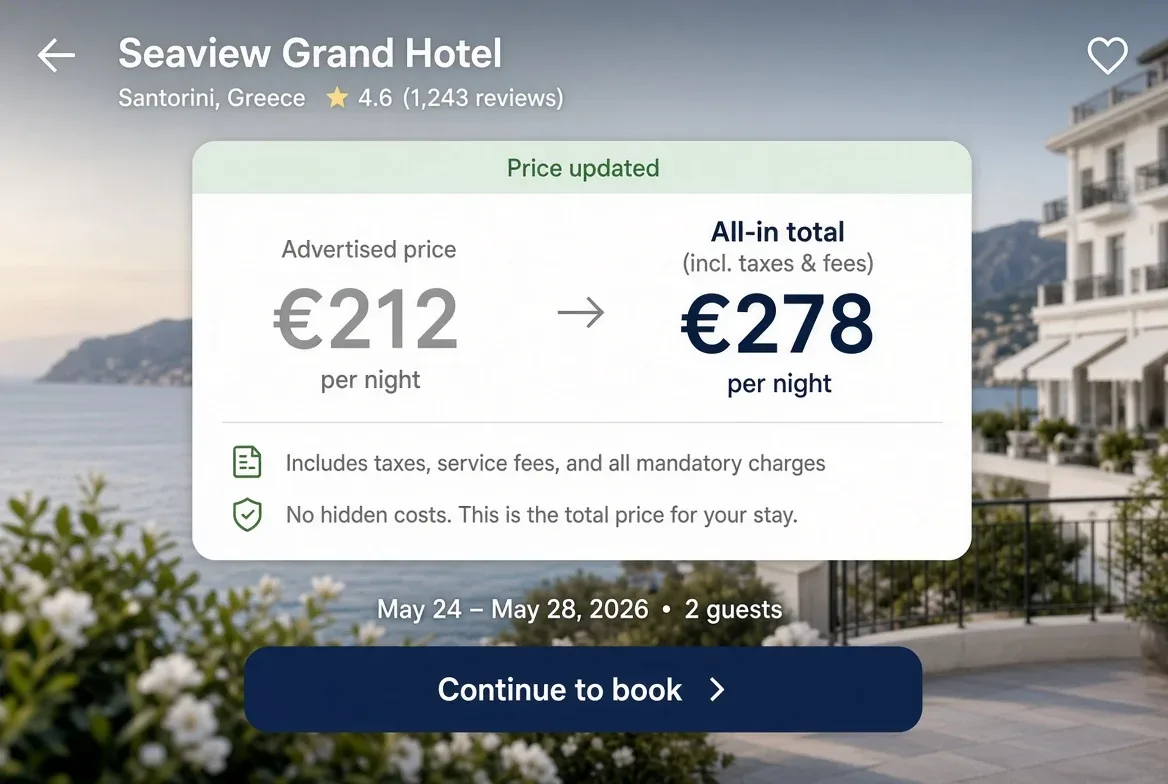
If you're comparing hotel or vacation-rental prices, the total you see is now supposed to be the number you actually pay, mandatory fees included — the FTC's Rule on Unfair or Deceptive Fees took effect on May 12, 2025. It doesn't ban resort or destination fees; it requires sellers to build them into the price shown up front instead of adding them at checkout.
That's the short version. The longer one, useful if a listing's price now looks different than it used to, or if you're trying to work out whether a checkout jump is even legal anymore, comes down to what the rule requires, what it still allows, and who's supposed to enforce it. This explainer, filed under Daily News Voyage's business news coverage, works through it using the FTC's own rule text and industry reporting on how it's playing out.
What the rule actually requires
The FTC finalized the rule on December 17, 2024, to stop "bait-and-switch pricing and other tactics used to hide total prices and bury junk fees" in two industries specifically: live-event ticketing and short-term lodging. The agency defines short-term lodging broadly enough to cover hotel rooms and vacation rentals alike. Whenever a business offers, displays, or advertises a price for either, it now has to disclose the true total price — including all mandatory fees — clearly and conspicuously, and that total has to be shown more prominently than any other pricing information on the page. A business can still itemize the resort fee, the cleaning fee, or the service charge underneath the total; it just can't let a smaller number be the one that grabs your eye.
What's still allowed
The rule doesn't cap fees or ban any of them by name — it targets how they're disclosed, not how much they cost. Government taxes and any charge a seller genuinely can't calculate until later in the booking flow, like some local occupancy taxes, can be left out of the advertised price. But the seller then has to clearly disclose the nature, purpose, identity, and amount of that fee before you're asked to enter payment information — not buried three screens past checkout. Truly optional add-ons, like a spa credit or early check-in, are a separate case and can still be presented separately, since they're not mandatory to complete the booking.
Does this cover Airbnb-style rentals, not just hotel chains?
Yes. The FTC's language covers "hotel rooms or vacation rentals" under the same short-term lodging category, and the rule reaches beyond the property listing the price on its own site — it also applies to the booking platforms and intermediaries in between. Laura Chadwick, president and CEO of the Travel Technology Association, told Hotel Dive that the rule governs business-to-business handoffs too: if a hotel or property supplies inaccurate pricing to a booking intermediary, and that intermediary passes the bad number on to a traveler, the FTC can pursue the transaction between the supplier and the intermediary as well as the one with the consumer. In practice, that pushes the accuracy requirement back up the chain to whoever sets the rate first.
What happens if a business doesn't comply?
The FTC can pursue civil penalties against violators; then-Chair Lina Khan said at the rule's December 2024 announcement that firms using "bait-and-switch pricing tactics" would be subject to them. The commission's vote to finalize the rule was 4-1. There's also a practical, less dramatic form of pressure: Hotel Dive reported that some hotel companies have already adjusted how they display fees in response to corporate travel buyers pushing back on hidden costs, though one travel-management executive quoted in the piece described smaller, independent properties as more dependent on fee revenue and slower to change.
What to actually check before you book
Look at the total price at the point you first see a rate, not just the headline number in search results. If a listing shows one number in a results grid and a meaningfully higher one only appears once you're deep into checkout — past the point where mandatory fees should already be disclosed — that's the exact pattern the rule was written to stop. The FTC's consumer guidance is direct about what to do next: if you think a company isn't following the rule, you can report it at ReportFraud.ftc.gov. The rule doesn't guarantee a lower price. It's meant to guarantee that the first total you see and the one on your final receipt are the same number.
For more context, read The Michelin Guide's Price Tag: How Cities Pay to Get Rated.
For more context, read Paris: How to Buy and Use Metro Tickets for a City Break.
For more context, read Vienna: Which District Fits Your City Break.