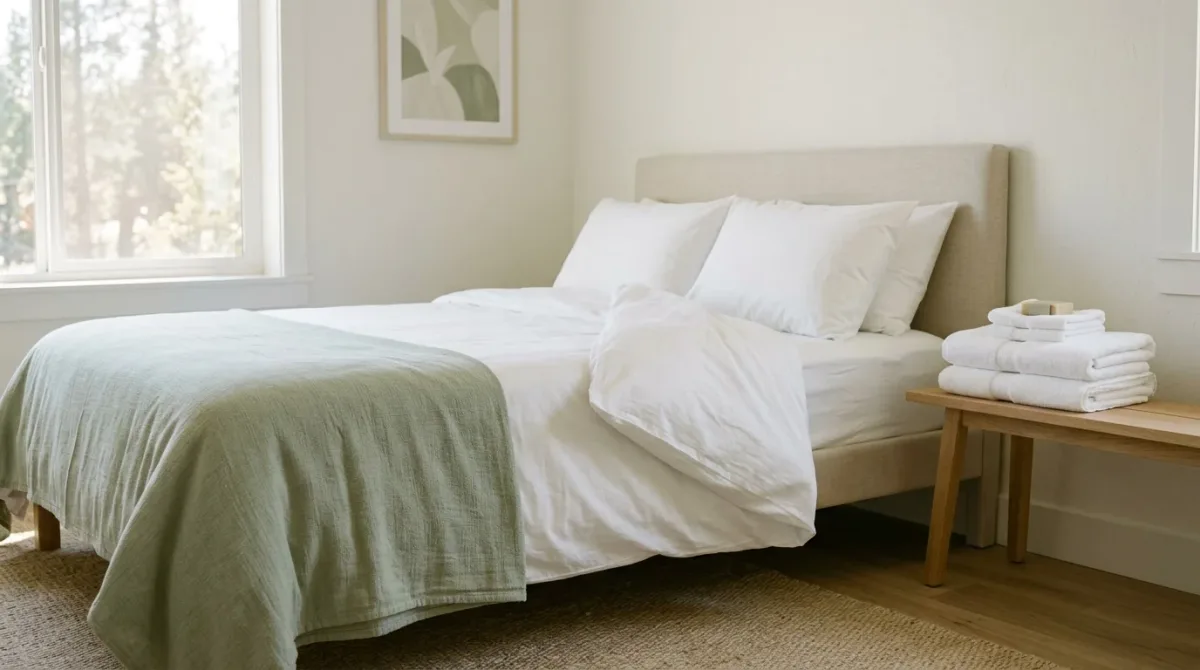
Opt-out housekeeping — offering daily cleaning only on request — reduces rooms cleaned per day, not labor cost per room, and the savings materialize only when schedules are rebuilt around the lower volume. The median U.S. housekeeper earned about $14 per hour as of May 2023, per the Bureau of Labor Statistics' occupational data, and each skipped room-clean saves on the order of 20–30 minutes of that wage — roughly $5–$7 in direct labor, before scheduling effects. The program is a scheduling decision disguised as a guest preference.
Delta Quattro publishes trade analysis, not advice; figures are sourced with period below.
What changed after 2020?
Several major brands made housekeeping-on-request standard during the pandemic staffing crisis and kept it. Marriott, Hilton, and Hyatt all moved to on-request or reduced-frequency models across broad portfolios, per company statements from 2020–2022, initially framed as a health measure and retained as a labor measure.
The staffing math drove the retention. Hotel housekeeping employment fell sharply in 2020 and had not fully recovered years later, per BLS industry employment data — leaving properties cleaning rooms with fewer people, and opt-out programs absorbing the gap.
What does an opt-out actually save?
Per room, the direct saving is the minutes of a standard clean at the housekeeper's wage — the $5–$7 order of magnitude above, using the BLS May 2023 median of about $14 per hour and industry-standard clean times. The property-level saving is different arithmetic entirely: fewer cleans per day means fewer housekeeper-hours needed per day, but only if shifts are cut to match.
The failure mode is familiar: occupancy rises, opt-out rates fall below forecast, and the property pays overtime to cover the volume it stopped scheduling for. The saving is real at 20% opt-out and negative at 8% with the same roster.
What does it do to the guest side?
Two documented effects. First, mid-stay satisfaction: reviews and guest-satisfaction surveys after the switch showed complaint clusters around unrefreshed rooms, particularly on longer stays, per guest-experience analyses reported in trade research. Second, tipping and service perception — daily housekeeping is one of the few service touchpoints in the stay, and removing it removes a visible service from the rate guests think they paid for.
Loyalty-program incentives to opt out — the points some brands offer for declining service, per their published program terms — push the opt-out rate up but concentrate the pattern among the most price-sensitive guests, where it does the least brand harm and the most per-stay saving. That is a defensible trade; calling it a sustainability program is not, and several brands' own framing has shifted from environmental to operational language since 2021.
How should an operator structure it?
The mechanics that determine whether the program pays:
- Publish the opt-out and the incentive at booking, not at check-in — the choice set expectations before arrival.
- Track opt-out rate weekly by segment and length of stay; the blended average hides the business-traveler pattern that drives it.
- Schedule to forecast cleans, not occupied rooms — the roster follows rooms-cleaned demand, which is the whole point.
- Cap consecutive skipped cleans — refresh every third or fourth day — to hold satisfaction on longer stays.
- Price the incentive honestly: loyalty points cost less than a clean, or the program is backwards.
What is the honest verdict?
For operators, the math changes at the margin. Opt-out housekeeping is a genuine labor tool in high-cost markets with stable business-travel mix, and a satisfaction risk in leisure and family segments where the daily clean is part of the expected product. The evidence supports running it segmented rather than property-wide — the choice most large brands have quietly made, per their program terms, even where the marketing says otherwise.
For more context, read Why does SoHo's storefront mix keep turning over?.
For more context, read Vienna: Which District Fits Your City Break.
For more context, read Paris: How to Buy and Use Metro Tickets for a City Break.