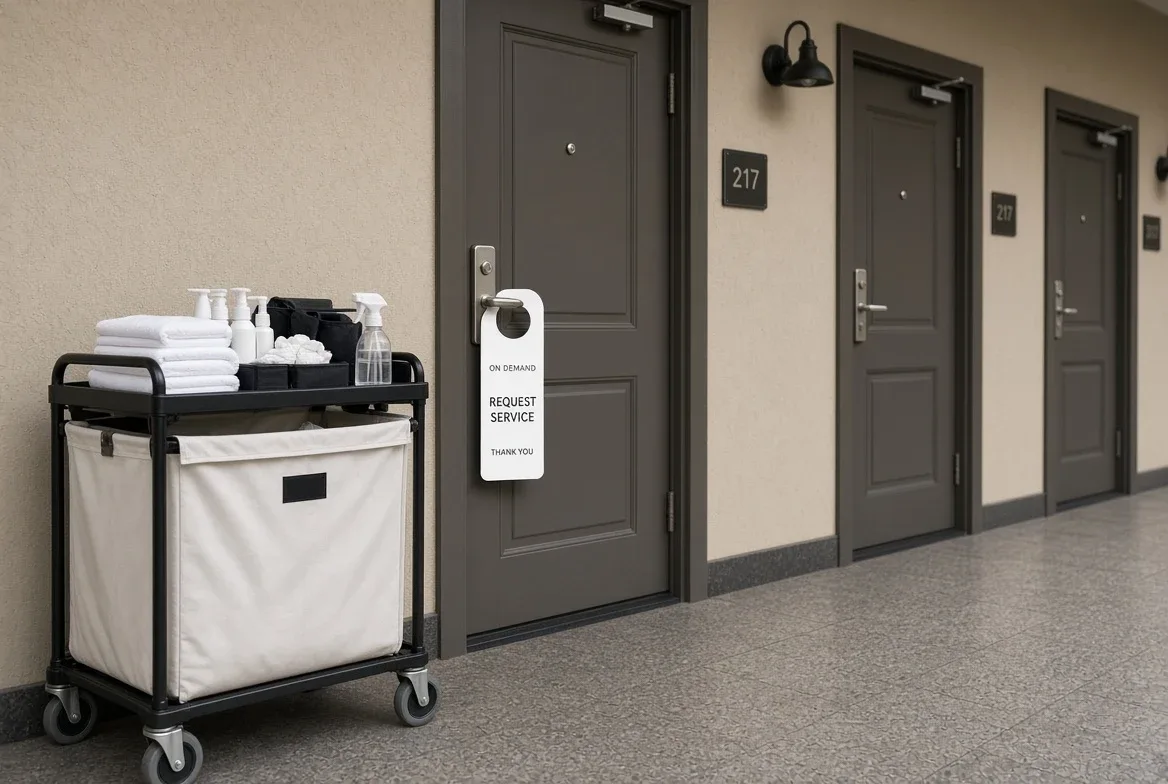
Housekeeping on request is a staffing model in which hotels clean an occupied room only when a guest asks for it, rather than automatically every day. As of March 2022, 93% of U.S. hotels offered daily room cleaning strictly on request rather than by default, according to a survey by the American Hotel & Lodging Association (AHLA). For operators, the model reshapes one of a property's largest controllable labor costs — and shifts a service that guests used to expect into one they now have to ask for.
For operators, the math changes at the margin.
How did on-request housekeeping become the default?
The practice started as a pandemic contact-reduction measure and never fully reversed. AHLA's March 2022 survey found 93% of hotels had moved to on-request cleaning, and framed the shift as aligned with CDC-era guidance on reduced room entry during a stay.
Hilton made the model formal in July 2021, ending automatic daily housekeeping across its non-luxury North American brands, according to The Points Guy. Guests request service by contacting the front desk; extended stays of five nights or more still trigger an automatic full cleaning. Luxury brands — Waldorf Astoria, LXR and Conrad — kept daily service, as did the company's Asia-Pacific resorts, while Europe, the Middle East and Africa moved to the on-demand model. A Hilton spokesperson described the change as giving guests "the flexibility of on-demand housekeeping services."
Marriott and Disney took narrower versions of the same approach: Marriott properties generally clean on request but run an automatic cleaning on every sixth night of a stay, while Disney World hotels shifted to light service — towel and trash changes — every other day rather than full daily cleaning, CBS News reported in March 2022. No two brands landed on an identical cadence, which is the point: each set its own trigger for when on-request cleaning reverts to automatic.
| Brand / property type | Default cleaning cadence | Automatic-clean trigger |
|---|---|---|
| Hilton (non-luxury, North America) | On request only | Automatic full clean at 5+ consecutive nights |
| Hilton luxury (Waldorf Astoria, LXR, Conrad) | Daily | Not applicable |
| Marriott | On request | Automatic clean every sixth night of a stay |
| Disney World hotels | Light service every other day | Towel and trash service only; no full daily clean |
The pattern across brands is a floor, not a ceiling: on-request is the default everywhere except the top rate tiers, and every brand still builds in some automatic trigger rather than leaving cleaning entirely to guest-initiated requests for the full length of a stay. That detail matters operationally — a pure opt-in system without a trigger risks rooms going uncleaned for the entire visit, which raises turnover and maintenance costs at checkout that can offset any daily labor savings.
What does the model save operators, and what does it cost them?
The savings case is a labor-efficiency argument, not a published per-room dollar figure. Hilton chief executive Christopher Nassetta told investors in February 2021 that the company was focused on "creating more labor efficiencies" and building "higher-margin businesses" that require "less labor than pre-COVID," per CBS News's reporting. Fewer daily room turns means fewer housekeeping labor-hours scheduled per occupied room, which is the direct lever operators are pulling.
That labor lever matters because the pool of workers to schedule against has not fully recovered. The leisure and hospitality sector lost 8.2 million jobs — a 49% decline — in March and April 2020, and as of CBS's March 2022 reporting remained 1.5 million jobs short of pre-pandemic staffing levels. Reduced cleaning frequency has functioned, in part, as a way to run properties with a smaller housekeeping bench.
On the cost side, the offset has been supply and materials inflation rather than labor. A survey of roughly 500 hotel operators cited by CBS News found a 79% average increase in cleaning and housekeeping supply costs as of November 2021, which narrows some of the labor savings on the expense line even as scheduled hours fall.
Labor advocates dispute that the trade-off nets out in the industry's favor. D. Taylor, international president of the hotel workers' union Unite Here, argued in the same CBS News report that stripped-down cleaning erodes the core service a hotel sells: "Without cleaning, what stops a hotel from being just a more expensive Airbnb?" Unions in several markets have pushed for cleaning mandates on hygiene and workload grounds, a tension operators weighing the model still have to account for.
What do guests actually want?
AHLA's March 2022 data suggests guest demand, not just cost pressure, now supports the model: 70% of guests said they do not want daily housekeeping. Among that group, 38% preferred cleaning only when requested, 19% preferred cleaning at checkout only, and 12% had no preference either way.
That preference has precedent. An earlier AHLA survey of more than 2,000 U.S. travelers, including over 700 categorized as frequent travelers taking five or more trips a year, found in August 2020 that 86% said suspending daily housekeeping would increase their comfort level, and roughly 60% said they would not be comfortable with housekeeping staff entering their room without advance permission. Hilton told investors on its August 2020 earnings call that "the majority of Hilton guests are currently opting not to receive daily housekeeping services," a pattern that predates and helped justify the formal 2021 policy change.
What should operators weigh before setting the policy?
- Staffing model: on-request cleaning lowers the number of daily room-turns to schedule against, easing pressure on a housekeeping labor pool that AHLA and CBS both describe as still short of pre-pandemic levels.
- Segment fit: extended-stay and loyalty-heavy properties can lean on automatic cleanings at fixed intervals — Marriott's sixth-night model is one version — rather than a pure opt-in system.
- Brand tier: full-service and luxury properties have generally kept daily service by default, reflecting a guest expectation tied to price point, as Hilton's luxury-brand carve-out shows.
- Labor relations exposure: markets with hotel-worker union mandates on cleaning frequency, or active organizing around workload, carry a compliance and negotiation dimension that a pure cost calculation misses.
- Supply-cost offset: rising costs for cleaning materials mean labor-hour savings from reduced frequency do not translate one-for-one into net operating savings.
The direction of travel is settled: on-request cleaning is now the majority model, not the exception. What operators are still sorting out is how far to push it by segment, brand tier and market — and how to defend the choice to a workforce and a labor movement that read the same shift as a service cut.
For a related hotels perspective, read CHECK IN IF YOU DARE: PEACOCK AND BLUMHOUSE ARE TAKING OVER THE STANLEY HOTEL THIS OCTOBER.
For more context, read The Michelin Guide's Price Tag: How Cities Pay to Get Rated.
For more context, read Why does SoHo's storefront mix keep turning over?.
For more context, read Paris: How to Buy and Use Metro Tickets for a City Break.