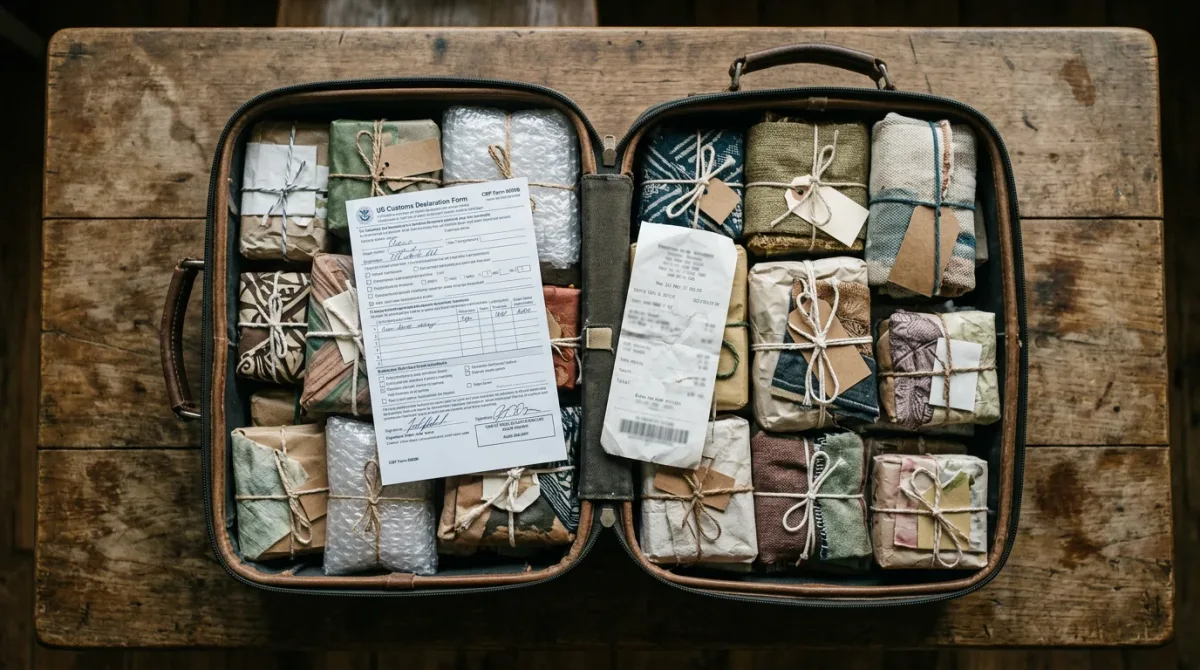
You can bring home up to $800 in purchases duty-free once every 30 days, per person — not per family. Stay abroad at least 48 hours, keep the goods in your bags, and declare everything. Go over $800 and U.S. Customs and Border Protection calculates duty on the excess at the port of entry, item by item.
What the $800 exemption actually covers
The exemption is a personal allowance, not a household one. According to U.S. Customs and Border Protection (CBP), the goods have to be "for your personal or household use or intended to be given as gifts," and they have to travel in your baggage — not mailed ahead separately (CBP, as of Aug. 20, 2026). You also need to have been outside the U.S. for at least 48 hours, with limited exceptions for trips to Mexico. Every item has to be declared, even the small stuff, because CBP totals the whole haul before applying the exemption.
How much duty-free room do you actually get?
The exemption isn't a single flat number — it depends on where you traveled and how long you stayed. Here's the tier structure CBP publishes, current as of Aug. 20, 2026:
| Exemption | Who qualifies | Key condition |
|---|---|---|
| $200 | Trips under 48 hours, or a second trip within 30 days | If the total value tops $200, the entire amount becomes dutiable — there's no partial credit |
| $800 | Most international destinations, including Caribbean Basin countries | Standard exemption for stays of 48 hours or more; usable once per 30-day period |
| $1,600 | Returning from the U.S. Virgin Islands, American Samoa, or Guam | Higher insular-possessions allowance, with its own alcohol rules |
Families cannot pool these numbers into one bigger exemption. Each traveler, including children, gets an individual allowance, but CBP is explicit that separate exemptions can't be combined into a single higher limit for one purchase.
What happens if you go over the limit?
Above your exemption, CBP calculates duty using the Harmonized Tariff Schedule, which sets rates by product category — there's no single across-the-board percentage for general merchandise. The one flat rate CBP does publish applies narrowly: alcohol brought in beyond the limits of the $1,600 insular-possessions exemption is charged "a flat duty rate of 1.5%," plus applicable Internal Revenue Service taxes. Outside that specific case, expect the port-of-entry officer to price the overage item by item, so hang onto receipts that show currency and purchase date — they're what the duty calculation is built on.
Mailing your purchases home instead? The rules just changed
If you're used to having a shop ship your purchase home rather than pack it, note that the ground has shifted. The federal government ended the separate "de minimis" exemption that let low-value packages mailed from foreign retailers enter duty-free, a change that took effect Aug. 29 as part of a broader executive action, extending what had already applied to Chinese and Hong Kong shipments to imports worldwide (Fodor's). That change hits packages sent by a retailer after you've left the store — it does not touch the $800 personal baggage exemption described above, which still applies to what you carry back yourself. Practically, that means shipping a rug or a chandelier home from a shop can now trigger duty and possible delivery delays that packing it in a suitcase would not.
What to watch for before you check out
Two habits keep the exemption working in your favor. First, ask for a paper receipt with the price, currency, and date on it for every purchase — CBP's calculation starts from what you can show, not what you remember. Second, track alcohol and tobacco separately from your general total: the standard $800 exemption allows up to two liters of alcohol, only one of which can come from outside the country you're returning from, while the $1,600 insular-possessions exemption allows up to five liters under its own sourcing rules. Going over on alcohol or tobacco can trigger duty on those items even when the rest of your shopping stays under the exemption.
Price reality
- Standard personal exemption: $800 per traveler, usable once per 30-day period, for stays of 48 hours or more (CBP, as of Aug. 20, 2026).
- Reduced exemption: $200 per traveler for shorter trips or a second trip within 30 days — and the entire value becomes dutiable if it exceeds $200 (CBP, as of Aug. 20, 2026).
- Higher exemption: $1,600 per traveler returning from the U.S. Virgin Islands, American Samoa, or Guam (CBP, as of Aug. 20, 2026).
- Comparison basis: figures reflect CBP's published exemption tiers checked Aug. 20, 2026; duty rates on specific goods above the exemption are set by the Harmonized Tariff Schedule and are not fixed percentages, except for the 1.5% flat rate on excess alcohol under the $1,600 exemption.
FAQ
Does the $800 exemption reset for each family member? Yes — every traveler, including children, gets their own $800 allowance. CBP is explicit that individual exemptions can't be pooled into one larger household total for a single big purchase.
What counts toward my $800 total? Anything acquired abroad for personal or household use, or intended as a gift, that you're bringing back in your baggage. It has to be declared whether it's worth $5 or $500.
Do I need receipts to prove what I paid? CBP's duty calculation is based on declared value, and a dated receipt showing the price and currency is the simplest way to support that figure at the port of entry.
Does shipping my purchase home instead of packing it change anything? Yes. Since the de minimis exemption for mailed retail shipments ended Aug. 29, packages sent separately from a foreign retailer can face duty regardless of value; the $800 baggage exemption only covers what travels with you.
Are alcohol and tobacco covered by the same $800 limit? They count toward your total value, but they also carry their own quantity caps — up to two liters of alcohol under the standard $800 exemption, with only one liter allowed from outside your return country.
For a related shopping news perspective, read How Much Can You Bring Home Duty-Free From a Shopping Trip Abroad?.