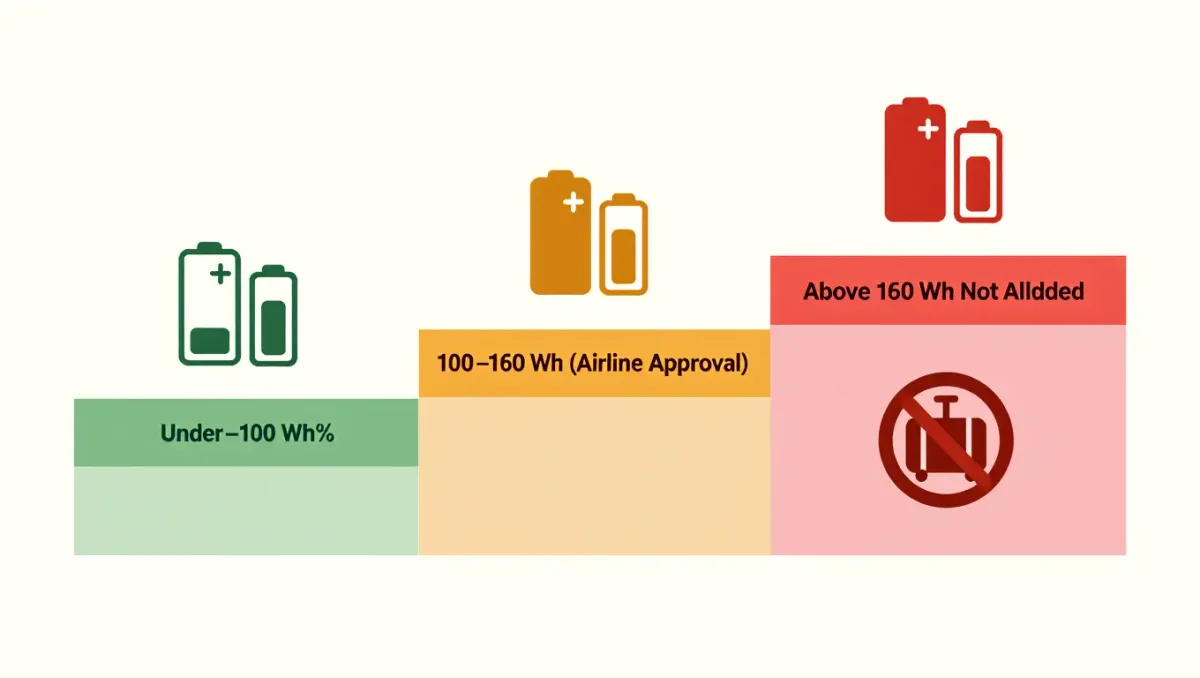
Any power bank rated 100 watt-hours or less — which covers essentially every consumer model up to about 27,000 mAh — is allowed in carry-on baggage on US airlines without airline approval, per FAA and TSA published rules as of mid-2026. Between 100 and 160 watt-hours, you need the airline's approval; above that, no. And in checked baggage, the answer is always no: spare lithium batteries and power banks are forbidden there regardless of size.
This is a comparison of published regulatory rules against manufacturer capacity labels, not a charging test. The watt-hour math is the tool that settles every case, and it takes ten seconds.
The ten-second conversion: mAh to watt-hours
Power banks are labeled in milliamp-hours; regulators write rules in watt-hours. The conversion published on every compliant label: watt-hours = mAh × volts ÷ 1,000, using the battery's nominal voltage — almost always 3.7 volts for the lithium cells inside. So the arithmetic for common sizes: a 10,000 mAh bank is 37 Wh, a 20,000 mAh bank is 74 Wh, a 26,800 mAh bank lands just under 100 Wh at about 99 Wh. That's why 27,000 mAh is the effective ceiling of the "no permission needed" tier, and why a 30,000 mAh bank technically crosses the line into approval territory.
The three rule tiers at a glance
| Capacity | Typical label size | Carry-on | Checked bag |
|---|---|---|---|
| Up to 100 Wh | Up to ~27,000 mAh | Allowed, no approval | Forbidden |
| 100–160 Wh | ~27,000–43,000 mAh | Airline approval required (limits apply) | Forbidden |
| Above 160 Wh | ~43,000+ mAh | Forbidden | Forbidden |
Two universal conditions ride on top: the terminals must be protected from short circuit — a power bank loose in a bag with keys and coins is a hazard even at 20 Wh — and the label must show the rating or enough specs to compute it. An unlabeled brick invites confiscation, because the officer can't verify the tier.
Why checked baggage is the hard no
The rule's logic is fire response: a lithium cell that goes into thermal runaway in the cabin is seen immediately and can be handled with a containment bag; the same failure in a cargo hold is discovered late or not at one. That's why the FAA's published hazardous-materials rules allow installed lithium batteries in checked bags within limits but ban spares and power banks outright. It's also why "it fit in my suitcase last time" isn't evidence of anything except that nothing caught fire.
Airline-by-airline differences: smaller than buyers fear
Within the FAA-governed US market, published airline rules converge: carry-on only, 100 Wh free, 100–160 Wh by approval, usually capped at two spare batteries per passenger. International carriers follow IATA's near-identical model, with a handful of stricter outliers — some Asian carriers cap allowed capacity below 100 Wh or ban onboard use of power banks entirely, meaning you may carry one but not charge from it in flight. If your itinerary includes regional Asian airlines, check their published battery pages specifically; the US rules don't travel.
What this means for what to buy
For flights, the comparison favors 10,000–20,000 mAh banks: inside the free tier with margin, light enough for a personal item, and sufficient for three to five phone charges. Skip anything marketed above 27,000 mAh unless you've emailed the airline and gotten approval in writing — the capacity you can't board is dead weight. And note the plane's own seat power: on aircraft with USB or AC outlets, the biggest permissible bank is often unnecessary in the first place.
FAQ
Can I bring a 20,000 mAh power bank on a plane?
Yes — at 3.7 volts it's 74 watt-hours, inside the 100 Wh tier that flies in carry-on without approval on US airlines.
Can power banks go in checked luggage?
No. Spare lithium batteries and power banks are forbidden in checked bags at any capacity under FAA rules; they must travel in carry-on.
How do I know my power bank's watt-hours?
Multiply mAh by 3.7 and divide by 1,000. If the label doesn't show the rating or the specs, security can't verify the tier and may confiscate it.
Do airlines limit how many power banks you carry?
Typically yes — published rules commonly cap spare batteries at two per passenger in the 100–160 Wh approval tier, with quantity limits on smaller ones varying by carrier.